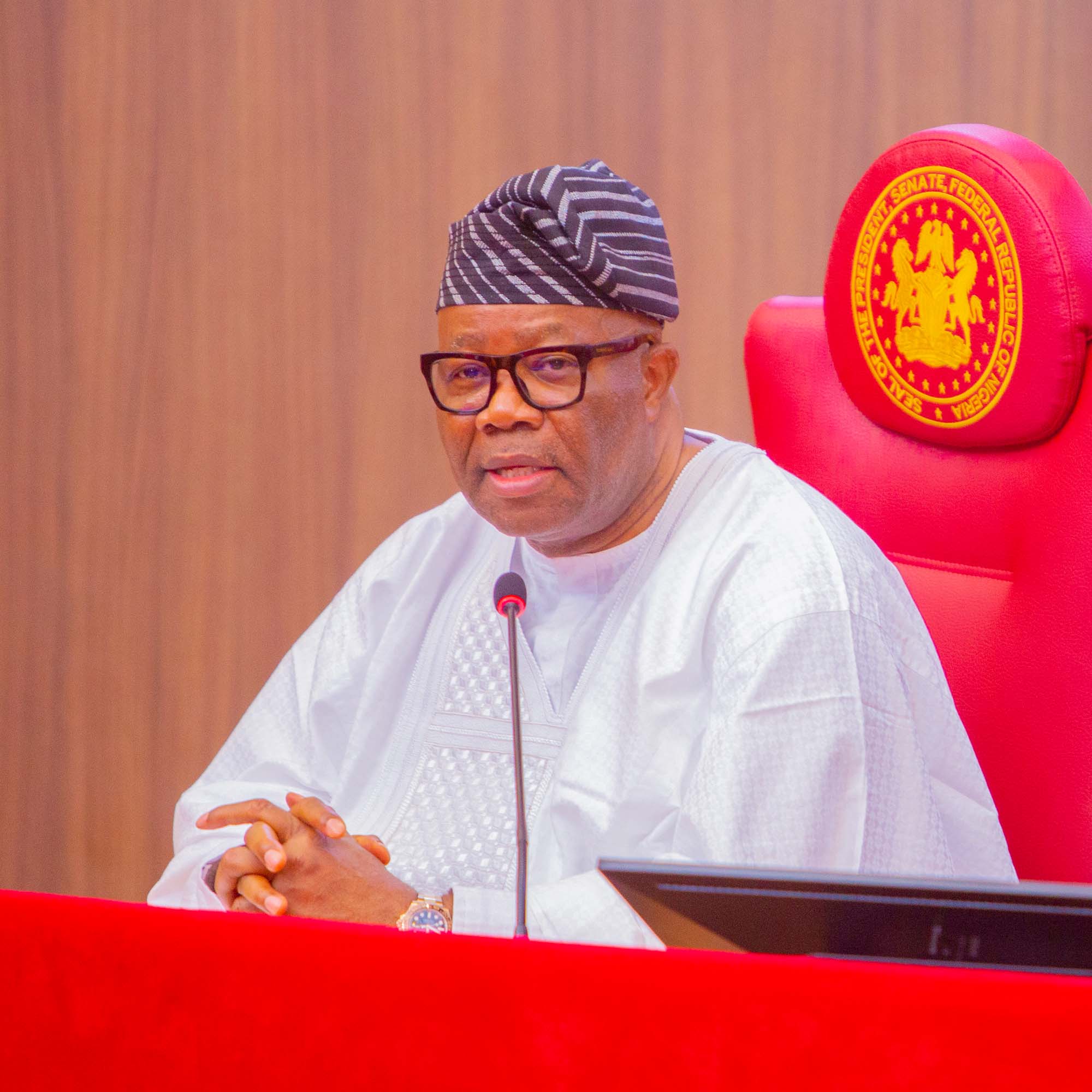
Can the same be said of Àkpábíò’s Senate, which appears to have surrendered its independence to the executive arm of government led by President Bola Tinubu?
By Tunde Odesola
Embedded in the bathroom struggle between my five-year-old daughter, Ara, and my three-year-old son, Ire, 17 years ago were the dynamics of power, control, courage, access, freedom, service, justice, and more.
If you missed the first part of this article, here is a recap of the story of my little children, whose innocent bathroom spat becomes a lens through which I will examine the Nigerian Senate. Ara, then five, had cleaned the bathroom, and her then three-year-old brother, Ire, was pressed to use it.
Ara refused; Ire insisted. Dilemma ensued.
Ara and Ire were two contending forces, while I, their father, represented the third force in a gyre of crisis, disputation, and intervention. Ara stuck to her conviction of cleanliness, control, order, rightness and service provision. Ire was prepared to defend his freedom of movement and access to the bathroom, demand service, and call for justice. Holding the doorknob to deny entry, Ara screamed, “Don’t pooh-pooh there!” Ire responded, “I want to pooh-pooh!”, holding his loose trousers in one hand.
In this scenario, I could be cast in the mould of an authority, a gatekeeper, who needed to solve a pressing problem. I listened to both parties, assessed the situation, and made a decision I thought was fair, just and peaceable to both parties.
Ara’s position is not necessarily illegitimate. Someone must maintain order and cleanliness. Ire’s demand for access is not necessarily unreasonable either. The crux of the matter is how I, the highest authority in the situation, exercise my power.
I did not punish Ara for refusing her brother access to the bathroom, nor did I punish Ire for insisting on his right to use it because I honestly did not know the circumstances that led her to wash the bathroom. Most importantly, I did not take sides; I just got the job done without fear or favour.
Can the same be said of Àkpábíò’s Senate, which appears to have surrendered its independence to the executive arm of government led by President Bola Tinubu? Àkpábíò heads a Senate that is active, busy, but not independent.
A legislature’s independence is measured not by the bills it mints, but by how often it slows down, modifies, rejects, or investigates executive and judiciary actions. Across 2023–2026, no major Tinubu bill was rejected, no corrupt agency head was removed due to Senate pressure, and oversight investigations on the Executive rarely produced consequences.
On March 31, 2026, precisely seven months ago, THE PUNCH reported that the Senate, which Akpabio represents, received two letters from President Tinubu, seeking approval for two borrowing facilities totaling $6 billion. What did Akpabio do? Àkpábíò read the President’s letters in the Senate, referred them to the Senate Committee on Local and Foreign Debts, and the committee recommended approval. Àkpábíò’s Senate approved the requests within hours, on the same day. Haba! Ọ̀gá Usain Akpabolt!
Again, I recall the statistics presented by the President of the Association of Psychiatrists in Nigeria, Dr Veronica Nyamali, who says one in every four Nigerians is living with a mental health challenge. The Nigerian Senate has 109 members. If the national ratio holds true within this microcosm of Nigeria, that means roughly 25% of Nigeria’s Senate may be facing mental health challenges.
I will not attempt to identify the 25%. But does Àkpábíò, who wants to send people who attempt suicide to prison, understand the mental health challenges confronting the very society he leads? Need I reiterate that one out of every four in a population of 109 senators equals 27.25 members? But there is no art to find a senator’s mental state on the face, even before the time of Shakespeare. Lizards crawl on their bellies without giving signs of bellyache. If the association of psychiatrists say 60 million Nigerians suffer from mental-health issues, shouldn’t Akpabio be on the vanguard of enacting bills that would promote mental health and improve healthcare delivery, to curb people from sliding onto a suicidal path? No, Akpabio won’t do that; he will pass bills from the executive with lightning speed.
Opposition presidential candidates, Atiku Abubakar and Peter Obi, have been vociferous in holding the Tinubu administration to account, criticising mounting foreign loans and demanding transparency in public finance, while Àkpábíò’s Senate is living up to its rubber-stamp nickname.
One in every four Nigerians is living with a mental-health challenge. But Àkpábíò wants to sweep mental health challenges being faced by Nigerians under the carpet. He says anyone who attempts suicide and fails will be jailed. Àkpábíò said so with his full chest, locating his reasoning in Christianity. But does fairness not warn those going up to meet with equity to go with clean hands? With its overindulgence of the executive, can Àkpábíò swear by the Holy Bible that his senate is working with the fear of God?
Àkpábíò is a “learned fellow”. In Nigeria, a “learned fellow” is basically a lawyer. A “learned fellow” may not be “a man of letters”. The two are different. Google search reveals a “man of letters” to be a learned scholar, author, or intellectual who has deep knowledge of literature and the humanities. So, it is apposite to show Àkpábíò how two of Nigeria’s foreign creditors and holiday destinations for senators treat suicide survivors. Here come England and the U.S.
I’ll start with a personal experience I had in the US. One sunny afternoon at my workplace, a friend told a female colleague that he was going to kill himself. I kept working on my laptop, thinking he was bragging. My female colleague repeatedly asked him, “You said you wanna kill yourself?” My friend said, “Yes.” My colleague asked, “How are you going to kill yourself?” “I’ll slit my wrist and bleed to death.” I think she recorded him. My female colleague went out and made a call. In about five minutes, an ambulance, a fire truck, and two police vehicles showed up at my workplace.
Ha! Wetin bi dis? Na so una dey do for here? My thoughts flew back to Nigeria.
The cops asked me a few questions: If my friend told me he was going to kill himself? Has he had a bad day? Since when has he been feeling frustrated? Etc. They asked my female colleague more questions.
He was immediately taken to a public hospital. His house was combed, and objects like knives, razors, guns, etc. were removed from his apartment. He was in the hospital for about one or two weeks at the expense of the state. He wasn’t charged with attempted suicide; he wasn’t sent to jail. He came back to his job after he was discharged. No one stigmatised him. The law took its course. Life went on.
In Edo State, Nigeria, a fuel tanker exploded in Oluku Market of Ovia North-East Local Government Area on October 15, 2026. Facebook has a viral video of one of the victims of the explosion being ferried away in a wheelbarrow. Where are our ambulances?
In 1961, the English, in their wisdom, enacted a law called the Suicide Act 1961. Its Section 1 abolished the rule that made suicide criminal in England and Wales, saying that a survivor cannot be prosecuted for attempting suicide.
The country which gave Nigeria independence did not stop in 1961. It went ahead to enact another law in 1983 and called it the Mental Health Act 1983. The law permits a mentally disturbed person to be admitted to hospital for assessment for up to 28 days, including the need for detention in a medical facility to safeguard the person and others. They call it a clinical and protective measure, not a criminal sentence that Àkpábíò is advocating.
Section 136 of the Mental Health Act 1983 provides for the police to take a person who needs immediate care or control to a place of safety for assessment and arrangements for care.
Whereas, under Section 327 of Nigeria’s Criminal Code, an attempted suicide can attract up to one year imprisonment. This is the type of law Àkpábíò is seeking to perpetuate.
In the U.S., attempted suicide is generally no longer treated as a criminal offence. A person having suicidal feelings or their relative can call or text 988, or use the online chat to speak with a trained crisis counsellor at any time. The service offers support and helps people connect with appropriate care. The survivor does not face criminal prosecution or a jail term.
Sports and recreation have a place in the fight against stress. Physical exercise has no age or class limit if your medical doctor certifies you fit. In the sports club in my hood, Agege Sports Club, the high and the low sweat it out on the pitch and courts, every Saturday. A traditional ruler, the Olu of Araromi Alade, HRM Oba Adeyemi Akanji Fatai Adelekan, Aladegbede II, does not miss any weekend session.
Oba Adelekan will be five years on the throne on Saturday, but he will be at the Agege Sports Club training ground in the morning of the same day.
Not all is gloom and grimace for Nigeria. The country’s Mental Health Act 2021 recognises psychiatric emergencies, including attempted suicide, without approving criminal prosecution. With his body language and influence in the Senate, however, Àkpábíò and his allies might stifle the bill sponsored by Senator Asuquo Ekpenyong (Cross River-South), seeking to decriminalise suicide attempts in Nigeria. An advocate of the Ekpenyong-sponsored bill, which has passed for second reading, is Senator Dayo Faduyile from Ondo-South.
The bill, commonly called the National Suicide Prevention Bill, is framed as seeking to “Establish a Framework for Suicide Prevention, Decriminalise Attempted Suicide and Provide for the Establishment of Support for Persons Who Attempt Suicide, and for Related Matters, 2026 (SB. 730).
This is the way Nigeria should go. Nigeria’s suicide laws should protect, prevent, and not prosecute.
* Concluded.
Email: tundeodes2003@yahoo.com
Facebook: @Tunde Odesola
X: @Tunde_Odesola